
On this page
- When is it time to replace gutters?
- Why upsize on replacement?
- What does a replacement involve?
- What should change in the new system?
- How much does replacement cost?
- Repair or replace?
- How long should new gutters last?
- What questions should you ask before replacing?
- What does a good replacement layout look like?
- What gets checked once the old gutters are down?
When is it time to replace gutters?
When repairs keep coming back. A few leaking corners on otherwise sound gutters are a repair job. Replacement makes sense when the faults are everywhere, or when the system was too small for the roof from the start. Call (470) 839-3794 and an independent contractor can tell you which applies.
| Sign | What it usually means |
|---|---|
| Leaks at many corners and joints | Sealant and metal have aged out |
| Sags that return after re-hanging | Fascia is failing or the metal is too thin |
| Rust, splits or holes in the trough | Galvanized steel near the end of its life |
| Spills in every heavy storm when clean | Gutters or downspouts undersized for the roof |
| Sectional gutters with seams every few feet | Many joints, many leaks |
| Soft, stained fascia along a whole side | Years of overflow behind the gutter |
Why upsize on replacement?
Because many homes here were built with gutters sized to a budget rather than to the roof. Forsyth County's median home was built in 2004, during years when the county was among the fastest-growing in the country, and builder-grade systems were commonly 5-inch, .027-inch aluminum with a downspout at each corner.
At NOAA's 10-year, five-minute intensity for Cumming of about 7.98 inches an hour, the This Old House sizing method gives a 5-inch K-style run about 630 square feet of roof at a 6/12 pitch, and a 6-inch about 905. A single back roof plane on a large two-storey house can be bigger than either. That is why replacement quotes here often specify 6-inch gutters on the large runs, 3x4 downspouts and extra outlets. See 6-inch gutters.
What does a replacement involve?
- Taking down the old system, including hangers, spikes and downspouts.
- Inspecting the fascia and drip edge, and replacing soft wood.
- Planning the new layout: run sizes, outlet positions, downspout count and size, and where each will drain.
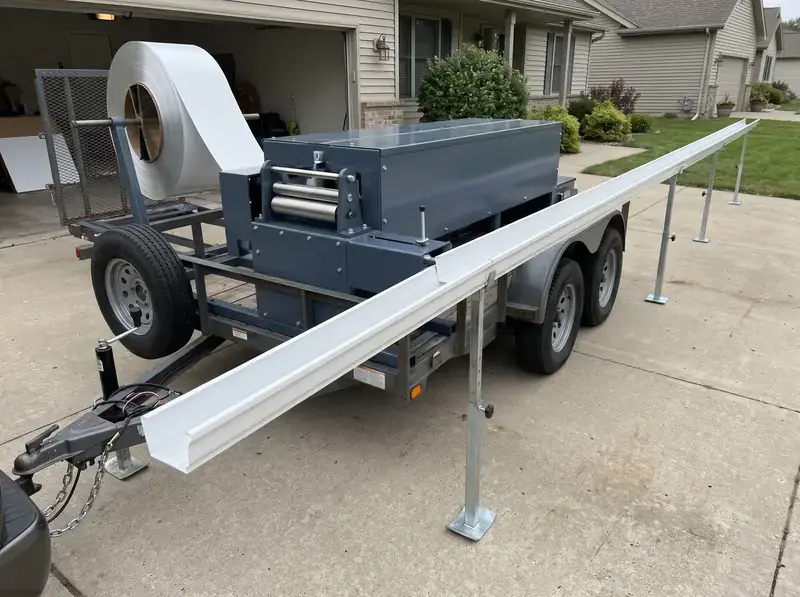
- Forming and hanging the new runs on screw-in hangers at close spacing.
- Sealing corners and ends, cutting outlets and fitting downspouts.
- Setting discharge with extensions, splash blocks or buried lines.
- Testing every run with water before the crew leaves.
What should change in the new system?
- Size where it counts: 6-inch on big planes and below valleys.
- More outlets: long runs drained from both ends.
- Bigger downspouts: 3x4 inch where the roof area is large.
- Thicker metal: .032-inch aluminum for long and exposed runs.
- Better hangers: screw-in hidden hangers instead of spikes.
- Better discharge: water carried well away from the foundation and the crawl space vents.
How much does replacement cost?
National guides put seamless aluminum at about $9 to $14 a foot for 5-inch and $11 to $17 for 6-inch, installed. Removal, fascia repair, extra downspouts and buried lines add to that. Ask for a written quote that separates the gutter, the downspouts and any wood repair. See the Cumming gutter cost guide.
Repair or replace?
If you are unsure, the repair or replace guide walks through the trade-offs: age, metal, number of faults, the state of the fascia, and whether the system is sized for the roof.
How long should new gutters last?
Well-installed seamless aluminum often lasts 20 years or more, steel depends on its coating, and copper lasts for decades. What usually ends a system early is not the metal but the details: hangers that loosen, fascia that rots behind overflow, and sealant at corners that ages out. A system sized for the roof, hung on screw-in hangers into sound wood and kept clean will outlast one that is not.
What questions should you ask before replacing?
- Which runs will be 6-inch, and why?
- How many downspouts, what size, and where will each drain?
- Will the old gutters be removed and hauled away?
- How will soft fascia be found and priced?
- Will the drip edge be checked or added?
- What hangers, at what spacing?
- What thickness of aluminum?
- What warranty on workmanship, in writing?
What does a good replacement layout look like?
Picture a large two-storey home with a walk-out basement. A sound layout might be: 6-inch gutters on the front and rear main planes, drained at both ends into 3x4 downspouts; 5-inch over the porch and garage; an extra outlet close to each corner below a valley; buried lines from the rear downspouts to pop-up emitters on lower ground; and extensions at the front where beds sit against the house. That is more downspouts and more metal than the builder fitted, and it is what keeps water in the gutter during a summer storm.
What gets checked once the old gutters are down?
The fascia along every run, the rafter tails behind any soft board, the drip edge and the first course of shingles. It is the one time the whole roof edge is exposed, so it is the best time to fix anything there.